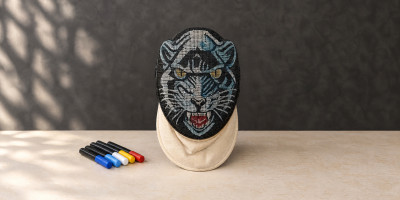










A bruise on an arm can be a training memory; a bad sword strike to the face can have far more serious consequences....
Foam, plastic, wood, or steel: which simulator should you choose to start HEMA?
You're starting Historical European Martial Arts (HEMA) and your club registration is confirmed. You've discovered a few guards, your first movements... and a whole new vocabulary. Now it's time to choose your equipment.
Faced with foam, plastic, wood, and steel swords, a question quickly arises: "Which one do I need to start with?"
The short answer
Choose a model suited to the exercises and partners in your group. You can start with foam, synthetic, or steel depending on the planned sessions. Wood is for more specific uses. There is no mandatory progression from one material to another.
A simulator is a training weapon that allows you to practice certain movements of the studied weapon. This guide mainly uses the longsword as an example: the needs differ for the rapier, saber, or staff.
What does the material change during training?
The feel in hand, the contact between weapons, and maintenance can change. Here are the initial pointers before looking at each category more closely.
| Material | What distinguishes it | The point to check |
|---|---|---|
| Foam | What distinguishes it A cover that cushions contacts. | The point to check The planned exercises and necessary protections. |
| Plastic | What distinguishes it Very varied constructions and sensations. | The point to check The specific model, its flexibility, and balance. |
| Wood | What distinguishes it A rigid construction, without flexion suitable for thrusts. | The point to check The authorized uses for this sword. |
| Steel | What distinguishes it Contact between metal blades and regular maintenance. | The point to check A design suited to the intended practice. |
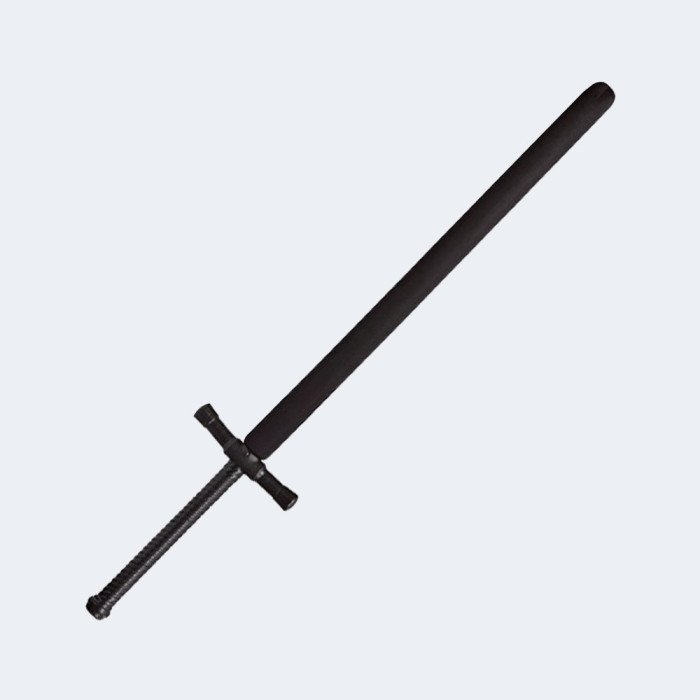
The foam covers the structure of the simulator. Example: GO-NOW longsword. See the model sheet
01 / Foam
Is a foam sword only for discovery?
It can accompany initiation, but also exercises in distance, timing, or decision-making. Its cushioning cover can help approach exchanges with less apprehension.
However, the coating, blade volume, and weight distribution give different sensations from a synthetic or metal blade. The work of contact between weapons is thus modified.
The reflex to keep: even with foam, movements remain controlled and protections adapted. The FFAMHE notably reminds of the need for additional rigid protections for thrusts, i.e., point strikes. FFAMHE guidelines, p. 3 and 6
A synthetic blade can be combined with metal parts. Example: EXO Blades. See the model sheet
02 / Plastic
Nylon, synthetic, plastic: is it the same thing?
"Synthetic" refers to a family; nylon is one of the possible materials. Other plastics are also found, like polypropylene, used for the EXO Blades blade illustrated here.
Two synthetic simulators can have significant differences in weight, balance, flexibility, and sliding on contact. At Blackfencer, for example, these characteristics vary depending on the blade options. Manufacturer's explanations
A detachable construction does not suffice to say a sword is flexible. If you can try the model used at the club, take advantage: you'll better understand the sensations described on its sheet.
The reflex to keep: "plastic" does not mean "with fewer protections." Heavy or rigid models require vigilance comparable to steel. FFAMHE guidelines, p. 5
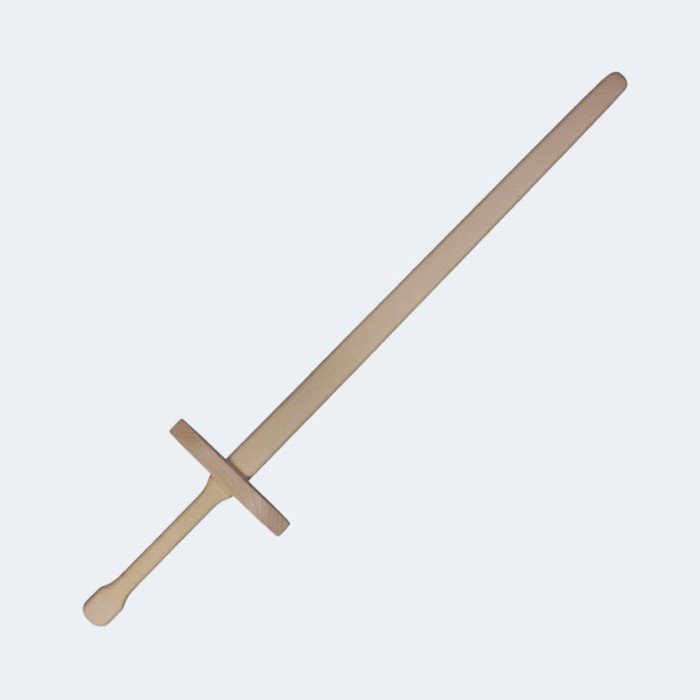
A rigid construction, reserved for suitable exercises. Example: SPES wooden longsword. See the model sheet
03 / Wood
Why choose a wooden sword?
A wooden sword can be used to repeat movements alone or to perform certain exercises defined by the instructor. Its shape and balance depend on the model: its interest is judged in relation to the planned work.
However, its rigidity imposes a clear limit: wooden swords should not be used for thrusts on a partner, as indicated by the FFAMHE. Other exercises must respect the intended use of the model and the session instructions. FFAMHE guidelines, p. 3
The reflex to keep: choose wood for an identified use. Also, check its condition before the session: a crack or splinter warrants setting the simulator aside.
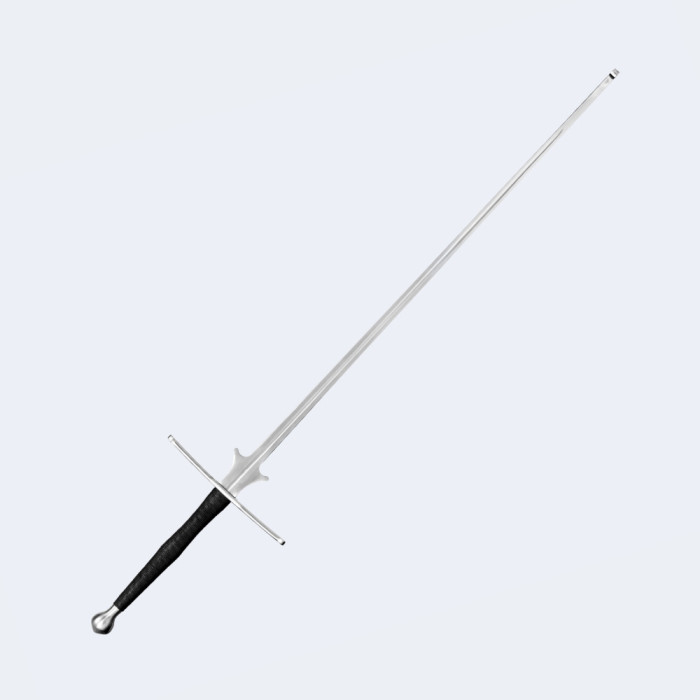
A Feder is a type of training longsword. Example: Meyer 1570. See the model sheet
04 / Steel
Can I start directly with steel?
Yes, if your club provides for it and supports you with the appropriate equipment and protections. There is no universal waiting period before using steel.
In longsword practice, you will often encounter the word Feder, or Federschwert: a type of training longsword. If your group works with Feders, a compatible model allows you to perform the same exercises with comparable equipment.
The length, weight distribution, tip, edges, and flexibility all matter. An unsharpened blade is not enough: the model must be designed for the intended training. Manufacturers offer different flexibilities, to be chosen according to the practice requirements. Regenyei's explanations
The reflex to keep: also plan for maintenance. Dry your simulator after the session, monitor corrosion and the blade's condition, and follow the manufacturer's instructions.
Try at the club: hold two authorized models with your gloves. Compare the available space on the handle, the balance, and the ease of holding a guard. Two swords of similar weight can give very different sensations.
Your turn to play
Three misconceptions to test
Three statements, three answers to check your understanding.
"A plastic sword always requires less protection."
False. The model, exercises, and planned intensity matter. Some synthetics require vigilance comparable to steel.
"I can start with steel if my club provides for it."
True. With a model, protections, and supervision suited to the sessions. There is no mandatory waiting period.
"If the sword's name is the same, the options don't change anything."
False. The length or blade option can change its behavior. Check the recommended variant.
And in your situation, where to start?
"My club gave me a reference."
Find the exact model and check its variants: length, blade, flexibility, or handle. A different option can change the simulator's behavior. If in doubt, clarify the reference before ordering.
"I can borrow a sword."
Ask for how long and for which sessions. You can organize your purchases and prioritize personal equipment needed right away.
"I don't have a list yet."
Ask about the type of simulator used in your group, models compatible with your partners', and expected protections. These three answers make the search much simpler.
What budget to plan for really starting?
The price of the sword is only part of the purchase. To compare two solutions, look at what you need to participate in the planned sessions:
Simulator + protections to acquire + possible delivery fees.
A pack can be practical when it matches your club's list. Buying individually is also suitable, especially if you already own some elements. Compare the useful content, sizes, and variants.
Before finalizing your cart
- The model and its variants match the instructions received.
- It is suitable for the exercises and simulators of your partners.
- The necessary protections are planned, either for purchase or borrowing.
- You have checked the sizes, deadlines, and total cost.
Your first equipment
A club list to decipher?
Send us the references or instructions you received. We will help you understand the product characteristics to prepare your choice.
Welcome to Faits d’Armes: new customers receive 5% off their first order. Contact us for offer details.
History is practiced.
Product photos: Faits d’Armes. The photographed products illustrate the presented categories; the choice is made according to your practice.